
We taught our AI to stop posting slop
Every AI social tool has the same problem, and for months we had it too. Ask a model to "write an Instagram caption" and you get the same shape every time: a hook, two emoji, and a row of hashtags. Ask an image model for a "vibrant, modern brand photo" and you get something that looks like a stock photo dreamed by a committee. Individually the posts pass. As a feed, they scream nobody is home.
That mattered to us more than most, because the whole point of Michii is that nobody has to be home. Your product team posts while you sleep. If what it posts is wallpaper, we have automated something worthless.
First, we looked at who actually wins
Before changing a line of code, we spent an afternoon scrolling the accounts every small-business owner secretly wants their feed to look like. Not to copy their content. To see what format the winning posts share.
| Account | What their grid is actually made of |
|---|---|
| Alex Hormozi (4.8M followers) | Tweet-style cards. White background, avatar, one bold opinionated sentence. That's the whole design. |
| Steven Bartlett (Diary of a CEO) | Editorial news cards. A red badge, an all-caps headline, small body text. A newspaper front page, shrunk to 1080 pixels. |
| Notion | Cream typographic cards in a locked brand system. Their own type, their own colors, every single time. |
| Dan Koe | Black cards with serif essays on them. Plain text, no photo at all, and tens of thousands of likes on a paragraph. |
Four very different brands, one pattern: the winning static post is designed typography carrying one specific idea. Not one of these accounts posts an AI-generated photo.
The image is not decoration for the caption. The image is the message, and it is made of words.
Which is exactly the thing a diffusion model cannot make. Image models garble text, so every AI tool explicitly prompts them to avoid words. We were generating the one kind of image that none of the winning accounts use.
Fix one: stop asking a paintbrush to do a designer's job
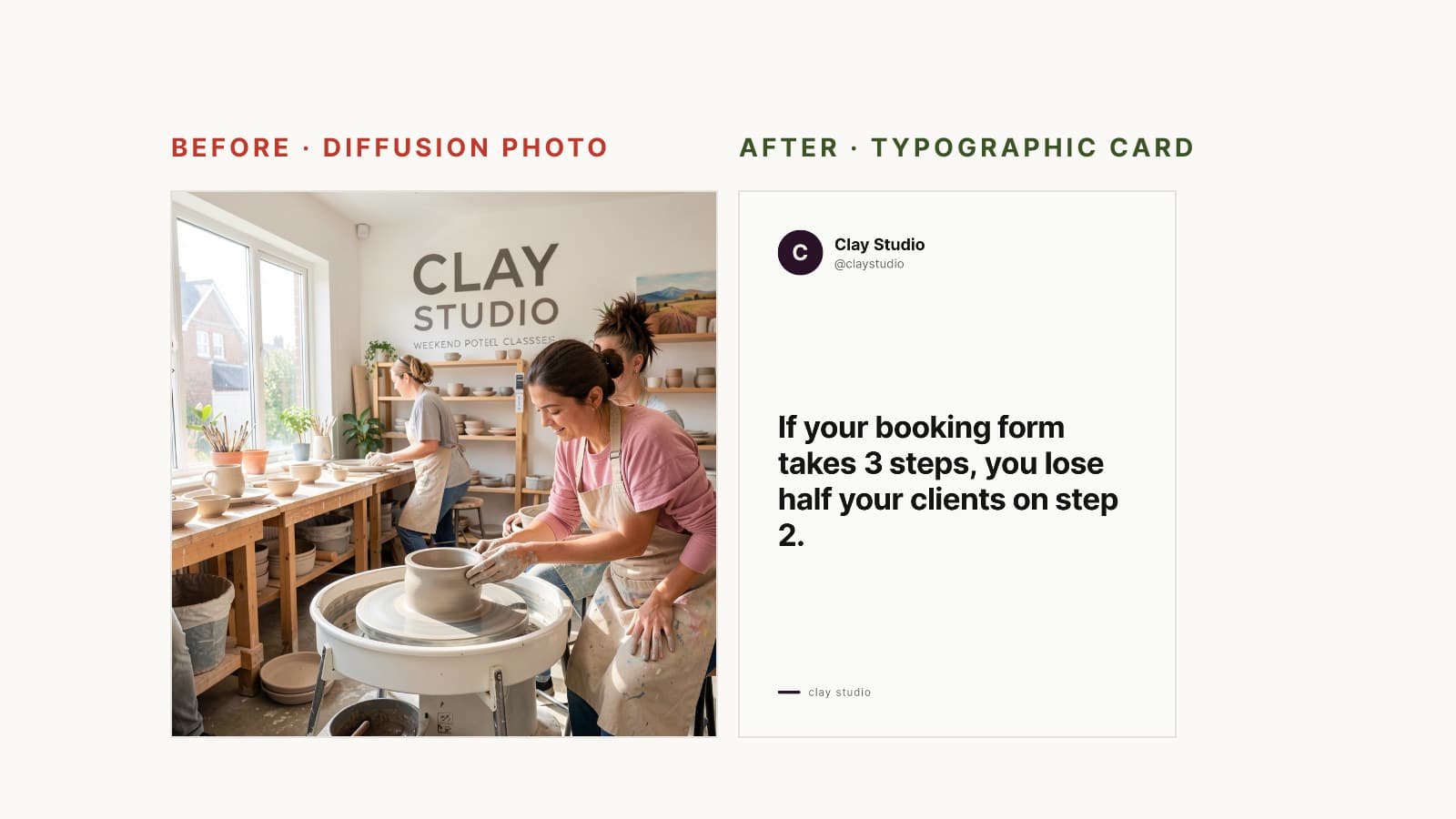
Look closely at the cover image of this post. The photo on the left is a real output of our old pipeline, prompt and all. We even told the model, firmly, to render no text anywhere. It painted a wall sign anyway: "WEEKEND POTEEL CLASSSES." That is not a typo we made for comedy. That is what image models do to words.
Typography is not a diffusion problem. It is a layout problem, and layout is what HTML has been good at for thirty years. So we threw out the "brand photo" prompt and built a small set of card templates that render as real HTML and get captured as the final image. Crisp type at any size, correct spelling every time, and a locked palette per brand, so a feed looks like one company rather than a random image search.
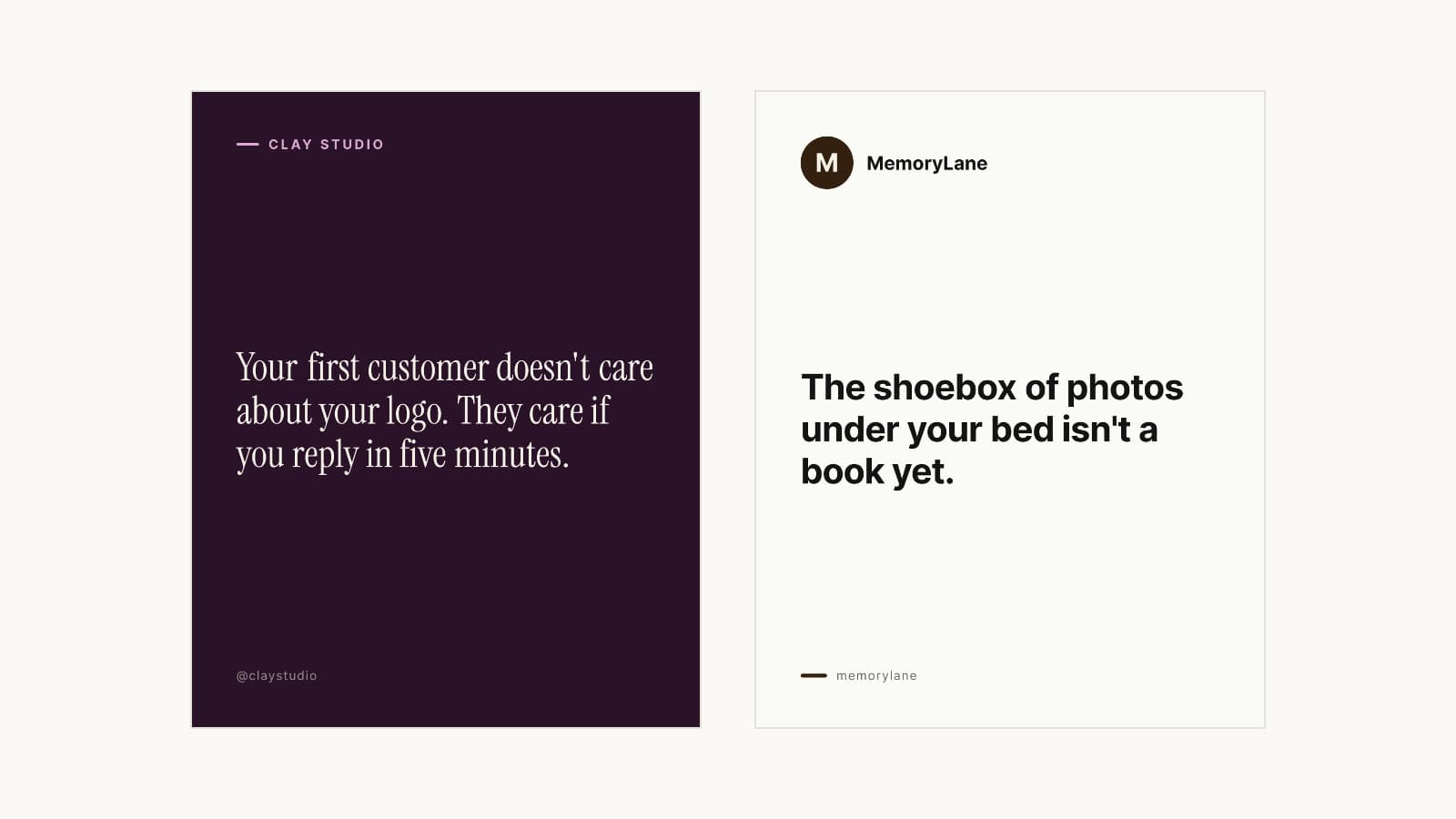
Every business on Michii gets its own mini design system: an accent palette chosen once, a serif voice and a sans voice, and templates the AI fills rather than invents. The model's job shrinks from "imagine a beautiful image" to "say one true sentence." Models are much better at the second one.
Photo generation still exists as a fallback for the rare post that genuinely needs a photo. But the default is now type.
Fix two: one idea, two surfaces
The subtler bug was structural. Our caption and our image were generated in parallel, from different prompts, and it showed. The caption said one thing, the image gestured at another, and neither committed.
Now the planner produces a single idea and renders it twice. The card headline is the hook: one opinionated, specific sentence, drawn on the image itself. The caption extends that idea with the story or the reasoning behind it, the way a good account writes below its own card. Same thought, two surfaces.
We also rewrote the caption rules from scratch:
- Say one specific, opinionated thing. If a sentence could appear on any brand's feed, it fails.
- Extend the card's idea, never repeat it.
- Hashtags are optional, one at most. A trailing row of hashtags is the loudest "AI wrote this" signal on Instagram.
- The filler vocabulary is banned outright: no "game-changer," no "elevate," no "unlock," no "in today's fast-paced world."
A few examples of the difference:
- ✕ "Great products take time. Trust the process."
- ✕ "Unlock the power of memories in today's fast-paced world."
- ✓ "The shoebox of photos under your bed isn't a book yet."
- ✓ "Your first customer doesn't care about your logo. They care if you reply in five minutes."
Next: letting the feed teach the planner
A designed post is still a guess. The next step, already researched and scoped, is closing the loop with Instagram's own numbers. Saves and follows-from-post are the honest signals, and every Michii post is tagged with its content pillar, its angle, and its visual format. Join those together and the planner can learn things like "how-to cards get saved, announcement cards don't" and quietly shift the plan, workspace by workspace, week by week.
That is the part we find genuinely exciting. Not an AI that posts for you. An AI that posts for you, watches what your audience actually keeps, and gets a little sharper every week while you sleep.
If you want a product team that treats your Instagram this way, start a business on Michii. Your part takes ten minutes.